If you are evaluating India as a country of origin for glass bottles, jars, cosmetic containers, or tableware, you are almost certainly weighing three things at once: landed cost, quality reliability, and supply-chain risk. This guide is written for that decision — not for someone learning what glass is, but for a procurement manager, packaging engineer, or brand owner deciding whether an Indian glass manufacturer belongs on their shortlist, and how to tell a capable one from a broker with a website.
India has quietly become one of the world's most important glass-sourcing origins. It is consistently among the top exporters of glass containers by shipment volume, ships glass and glassware to well over a hundred countries, and — since recent tariff changes on Chinese goods — has moved up to become one of the largest single sources of imported glass bottles into the United States. For buyers running a "China Plus One" strategy, India is frequently the plus one.
But "a glass manufacturer in India" is not a single, uniform thing. The country's glass sector spans everything from century-old hand-working clusters to fully automated, ISO-certified container plants. Choosing well means understanding that landscape, the material itself, how the product is actually made, and what separates a genuine manufacturer from a trading intermediary. That is what this guide covers.
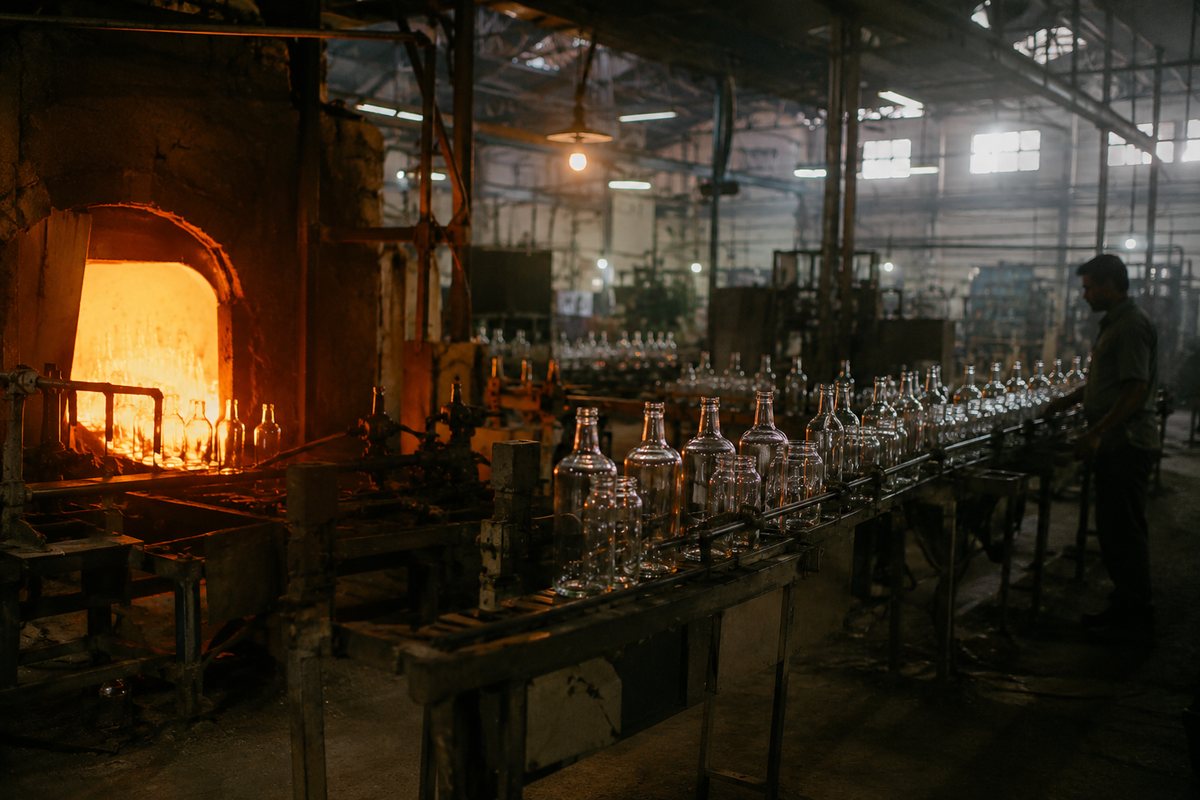
What "Glass Manufacturer in India" Actually Means
Before comparing suppliers, it helps to understand that India's glass industry is really two industries sitting side by side.
The organized sector is made up of large, capital-intensive plants running continuous tank furnaces and automated forming lines. These facilities dominate high-volume container glass — beverage bottles, food jars, pharmaceutical vials — and a handful of major players account for a large share of India's total glass output. This is the segment that competes directly with international container groups on scale, consistency, and certification.
The unorganized (or MSME) sector is a much larger population of micro, small, and medium units. It is highly concentrated, produces enormous variety, and is where much of India's decorative glass, specialty containers, tableware, and craft-oriented work originates. This sector is prized for exactly the things large automated plants struggle with: flexibility, short runs, hand-finishing, complex decoration, and willingness to develop bespoke molds for growing brands.
Firozabad: India's Glass City
Any serious conversation about glass manufacturing in India comes back to Firozabad, in Uttar Pradesh — known across the country as the "Glass City" (and historically as Suhaag Nagri). Glassmaking in the region traces back centuries, and today the cluster is responsible for a very large share of the country's glassware output and employs several hundred thousand people directly, with many more in ancillary trades. A significant portion of what Firozabad makes is exported.
What makes Firozabad strategically interesting for a buyer is the density of specialization. Within one cluster you find furnaces, mold-makers, decoration units, printing and frosting workshops, packaging suppliers, and export agents — an entire ecosystem where a single product can be developed, formed, decorated, and packed without leaving the region. That vertical proximity is a genuine sourcing advantage, particularly for customized and decorated glass where several processes must be coordinated.
Other important manufacturing bases exist across Maharashtra, Gujarat, Telangana, and elsewhere — often housing the largest automated container plants. But for OEM and private-label work that blends volume production with decoration and finishing, the Firozabad ecosystem remains a natural home.
Manufacturer vs. trader: the distinction that matters most
The single most important thing to establish about any "glass manufacturer in India" is whether they actually melt and form glass, or whether they buy finished glass and resell it. Both models exist, and both can be legitimate — but they carry very different implications for price transparency, quality control, customization, and accountability.
A true manufacturer controls the batch, the furnace, the molds, and the annealing and inspection lines. That control is what lets them guarantee dimensional consistency, develop new shapes from your drawings, and take responsibility for defects. A trader adds a margin and a layer of distance between you and the people who can actually fix a problem. Neither the website nor the sample tells you which you are dealing with — the factory audit does. We return to this in Section 11.
Why International Buyers Are Sourcing Glass from India
The shift toward India is not driven by a single factor. It is the combination of several, arriving at the same time.
China Plus One and tariff exposure. For years, China was the default origin for commodity and decorative glass. Recent tariff activity on Chinese imports into the United States has changed the landed-cost math for many categories, and buyers have responded by diversifying origins to reduce both cost and concentration risk. India, with an established export base and a broad product range, has been one of the primary beneficiaries. In US glass-bottle import data, India now sits among the top handful of source countries.
A mature export base. India already exports glass and glassware worth well over a billion US dollars annually to more than a hundred countries, with the United States, Germany, and the United Kingdom among the leading destinations. This is not an emerging capability being tested for the first time — it is an established trade lane with existing documentation, freight, and inspection infrastructure.
Cost structure. Competitive labor and a deep pool of skilled glass workers make India especially strong on decorated and value-added glass, where finishing is labor-intensive. For customized bottles and jars that require printing, frosting, spraying, or hand-finishing, India's cost advantage is often most pronounced precisely where automated Western plants are least efficient.
Product and design flexibility. The coexistence of automated volume plants and flexible MSME units means an Indian supplier base can serve both a national spirits brand's high-volume run and a D2C cosmetics startup's short, heavily decorated launch. Mold development for custom shapes is routine.
Growth momentum. India is one of the faster-growing container-glass markets globally, supported by rising domestic demand in spirits, food, pharmaceuticals, and cosmetics. That domestic demand funds furnace modernization and capacity that export buyers ultimately benefit from. It is worth noting that India's per-capita glass consumption remains lower than that of China or the US, which is one reason the industry has significant room to grow.
Procurement takeaway: India's strongest case is rarely "cheapest possible commodity glass." It is reliable, decorated, export-ready glass at a competitive landed cost, from an origin outside China. If your product needs printing, frosting, custom shapes, or private-label finishing, India's advantage compounds.
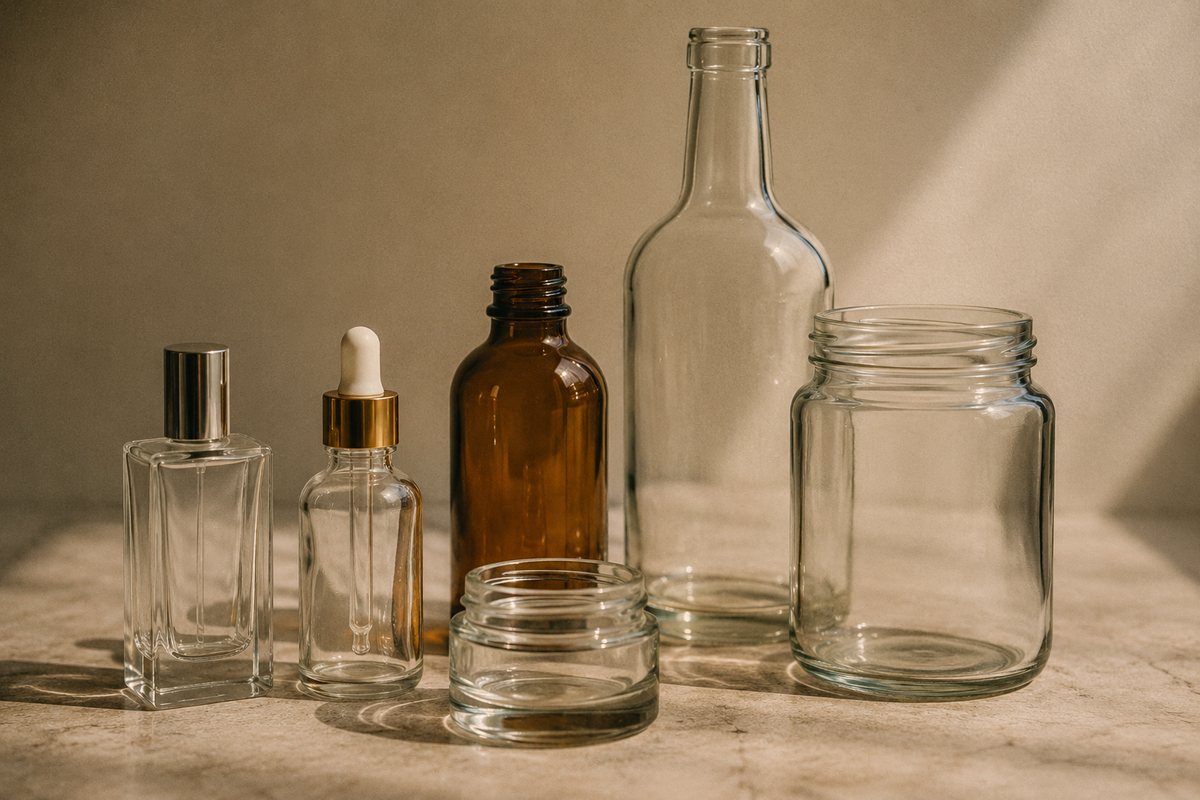
What Indian Glass Manufacturers Produce
The Indian glass sector covers a wide product range. The table below maps the main categories a B2B buyer is likely to source, with typical end-users and the glass characteristics that matter most.
| Product Category | Typical Buyers | Common Formats | What Matters Most |
|---|---|---|---|
| Spirits & beverage bottles | Distilleries, breweries, beverage brands | Flint, amber, super-flint bottles; 180 ml–1 L | Clarity/color control, weight consistency, closure fit, pressure resistance |
| Food & sauce jars | Food manufacturers, private label, condiment brands | Wide-mouth jars, honey/jam/pickle jars | Neck finish accuracy, thermal shock tolerance, cap compatibility |
| Cosmetic & personal-care glass | Beauty brands, D2C labels, contract fillers | Cream jars, dropper bottles, roll-ons, serum bottles | Decoration quality, cosmetic-grade appearance, tight tolerances |
| Perfume & fragrance bottles | Perfumers, luxury brands | Flint bottles, heavy-base bottles | Optical clarity, premium finish, crimp-neck precision |
| Pharmaceutical glass | Pharma, nutraceutical, CDMO | Type I/II/III bottles, vials, ampoules | Hydrolytic resistance, regulatory compliance, cleanliness |
| Candle glass | Candle brands, home-fragrance | Tumblers, jars, vessels | Thermal shock tolerance, finish, decoration |
| Tableware & glassware | Hospitality, retail, restaurant supply | Tumblers, stemware, bowls, dinner-set pieces | Consistency, decoration, mechanical durability |
| Decorative & specialty glass | Retail chains, gift, home décor | Vases, candle stands, art ware | Design range, hand-finishing, color |
A capable manufacturer will not necessarily make all of these. Container-focused plants specialize in bottles and jars; other units concentrate on tableware or decorative work. Matching your product to a supplier whose furnaces, molds, and inspection lines are actually built for that category is one of the most reliable predictors of a smooth program.
Understanding Glass as a Material
You do not need to be a glass technologist to source well, but understanding a few material fundamentals lets you specify correctly and evaluate quality claims critically.
Soda-lime glass (the workhorse)
The overwhelming majority of commercial containers and glassware are soda-lime glass — broadly, silica sand plus soda ash (sodium oxide) and limestone (calcium oxide), with minor additives. It dominates container glass because it is economical, easy to melt and form, chemically stable enough for food, beverage, and cosmetic use, and infinitely recyclable. When someone quotes you a standard bottle or jar, assume soda-lime unless stated otherwise.
Borosilicate glass (for demanding applications)
Borosilicate replaces some of the composition with boron oxide, giving far better thermal-shock resistance and chemical durability. It costs more and is harder to make, so it is reserved for applications that need it: pharmaceutical Type I glass (vials and ampoules for injectables), laboratory glassware, and some premium candle or heat-exposed products. If your product will hold an aggressive formulation or face rapid temperature change, borosilicate — or at least a properly de-alkalized/treated glass — may be a genuine requirement rather than an upsell.
Color, and why it is functional
Glass color is not only aesthetic:
- Flint (clear) maximizes product visibility — standard for spirits, food, cosmetics, and perfume.
- Amber blocks a large part of the UV spectrum, protecting light-sensitive contents such as beer, certain pharmaceuticals, and some oils.
- Green offers partial UV protection and is traditional for wine and some beverages.
- Custom and "super-flint" — extra-clear glass with reduced iron content — is specified where premium optical clarity signals quality, as in fine fragrance and premium spirits.
When you specify color, specify why. A supplier who understands that amber is protecting your actives, not just matching a Pantone, is a supplier who understands your product.
The properties that actually get tested
For containers, the specifications that appear on inspection reports typically include wall thickness and distribution, weight, capacity (brimful and to a fill line), dimensional tolerances (height, diameter, ovality), neck-finish accuracy for closure compatibility, internal pressure resistance, thermal-shock resistance, annealing quality (residual stress), and — for pharma and lab glass — hydrolytic resistance class. Understanding these lets you write a specification a factory can be held to, which we build on in Section 6.
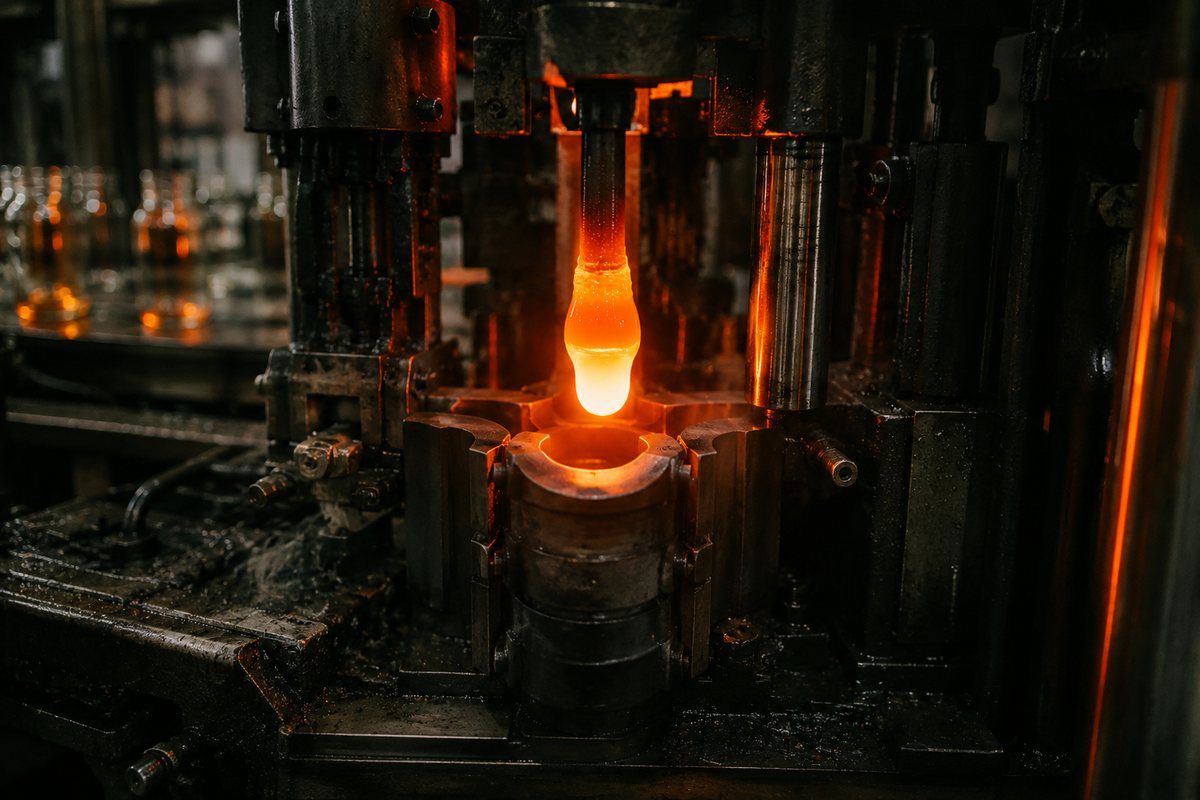
How Glass Is Manufactured: The Production Process
Understanding the process helps you ask sharper questions, spot where defects originate, and interpret a factory tour. Here is the container-glass production flow, end to end.
Raw materials (silica sand · soda ash · limestone · cullet) → melting at ~1,500 °C → forming (blow-blow / press-blow on IS machines) → annealing lehr (controlled cooling) → automated + manual inspection → packing & container loading.
1. Batch preparation. Raw materials — primarily silica sand, soda ash, and limestone, plus additives and cullet (recycled glass) — are precisely weighed and mixed. Cullet is important commercially and environmentally: it lowers melting energy and cost. The batch recipe determines color, clarity, and base properties.
2. Melting. The batch is charged into a furnace and melted at temperatures around 1,500 °C. The melt is then refined — held to remove bubbles (seeds) and homogenize — because the quality of melting and refining directly drives the defect rate downstream. Modern plants use continuous tank furnaces; smaller and specialty units may use pot or day-tank furnaces.
3. Forming. Molten glass is cut into precisely weighed "gobs" and delivered to forming machines. The two dominant methods: - Blow-and-blow — used for narrow-neck containers such as bottles. - Press-and-blow — used for wide-mouth jars and some lightweighted bottles, giving better glass distribution. High-volume plants run IS (Individual Section) machines; decorative and specialty work may be hand-blown or semi-automatic, which is exactly where India's skilled workforce adds value.
4. Annealing. Formed ware passes through an annealing lehr — a temperature-controlled tunnel that slowly cools the glass to relieve internal stress. Skipping or rushing this step leaves stressed glass that fails unpredictably. Residual stress can be checked with a polariscope; ask whether it is.
5. Surface treatment. Hot-end and cold-end coatings are often applied to improve strength and scratch resistance and to help containers move smoothly down filling lines.
6. Inspection. This is where a serious manufacturer separates itself. Good plants combine automated inspection (cameras and sensors checking dimensions, checking for cracks, stones, blisters, and other defects) with manual QC and sampling. Pressure testing, thermal-shock testing, and dimensional audits are performed against the agreed specification.
7. Decoration (if applicable). Printing, frosting, spraying, coating, and other finishing happen after forming — covered in Section 7.
8. Packing and loading. Approved ware is packed, palletized, and prepared for container loading and export — covered in Section 9.
Two questions cut to the heart of a factory's real capability: What is your annealing control? and What does your inspection line actually catch? The answers tell you more than any brochure.
Quality Standards and Certifications to Demand
"Export quality" means nothing on its own. What protects you is a written specification tied to recognized standards, plus evidence the supplier can meet it. Below are the reference points buyers should know and, where relevant, require.
| Standard / Reference | What It Covers | When to Require It |
|---|---|---|
| ISO 9001 | Quality management system | Baseline for any serious supplier — evidence of process control |
| ISO 719 / ISO 720 | Hydrolytic resistance of glass (grains) | Pharmaceutical, lab, and chemically sensitive contents |
| Type I / II / III (pharmacopeial) | Pharmaceutical glass classification | Any pharma, injectable, or nutraceutical container |
| ASTM references (e.g., for glass containers/testing) | Test methods and specifications | Technical/pharma buyers standardizing on ASTM |
| GMP / relevant food-contact compliance | Manufacturing hygiene, food-contact safety | Food, beverage, pharma, cosmetic |
| Internal pressure & thermal-shock testing | Mechanical/thermal performance | Carbonated beverages, hot-fill, candles |
| Dimensional & capacity tolerances | Fit, fill accuracy, closure compatibility | Every program — must be defined in the spec |
A few practical points that matter more than the certificate logos:
- Certificates prove a system exists, not that your specific order will conform. Pair certification with a per-order inspection regime and, ideally, a pre-shipment inspection (PSI) — yours or a third party's.
- Closure compatibility is a top failure point. Neck-finish tolerances must match your caps, corks, pumps, or droppers exactly. Provide closure samples or specs; don't assume "28 mm" means the same thread everywhere.
- AQL sampling. Agree an Acceptable Quality Level and defect classification (critical / major / minor) in writing before production, so "acceptable" is defined the same way on both sides.
- Retention samples and COAs. Ask for retained samples per batch and a Certificate of Analysis or inspection report per shipment.
- Don't invent compliance you can't verify. If a supplier can't produce test data for a claim, treat the claim as unproven — and expect a credible manufacturer to say plainly when a property "depends on the application" rather than over-promising.
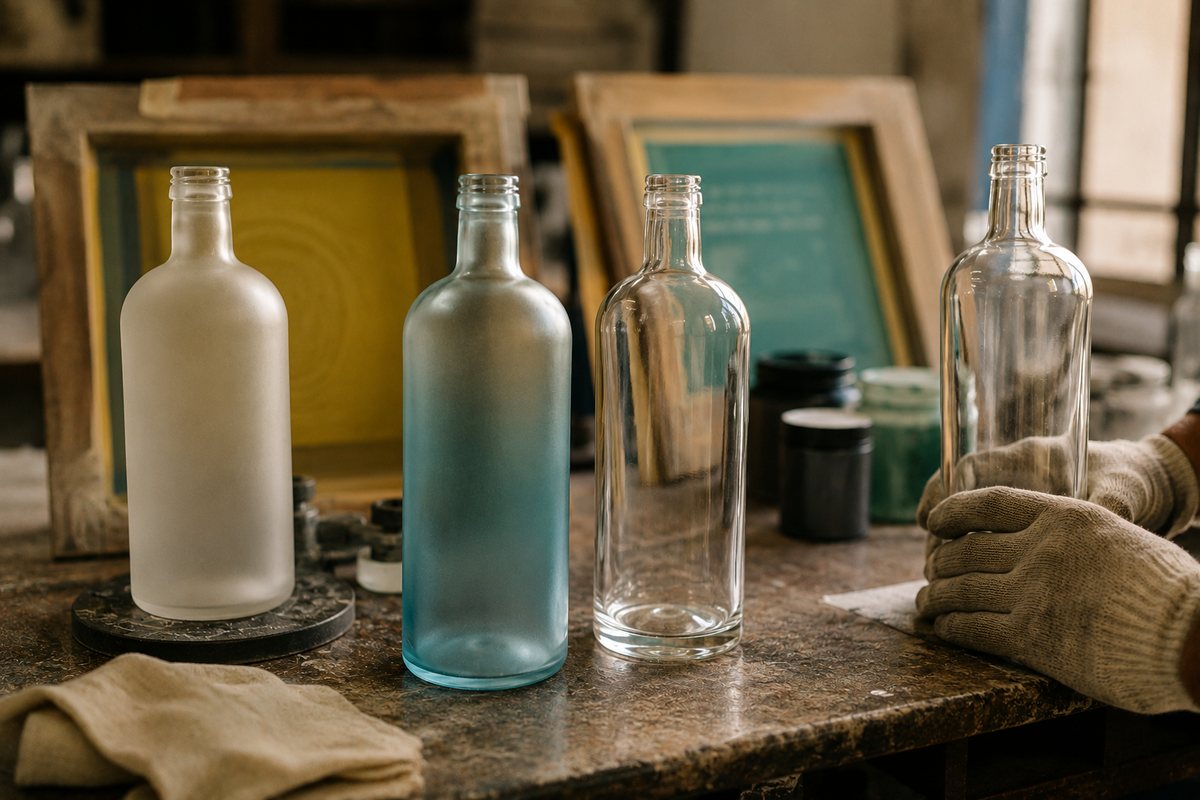
Customization, Decoration, and Private Label
For most brands, this is where India's supplier base is most compelling — and where "manufacturer vs. trader" matters most, because decoration is labor- and skill-intensive.
OEM manufacturing. Producing glass to your own drawings and specifications — your shape, your dimensions, your weight — typically via a custom mold. This is how brands get a container that is genuinely theirs rather than a catalog item.
Private label. Your branding applied to a proven base container, a faster and lower-tooling route than full OEM when a stock shape works for you.
Decoration options commonly available from Indian manufacturers include:
- Screen printing — durable, vibrant graphics and text directly on the glass; excellent for logos and multi-color designs.
- Frosting — an etched, matte finish (acid or spray), popular for premium spirits, fragrance, and cosmetics.
- Spray coating / color coating — full or gradient color applied to clear glass, enabling custom shades without a dedicated glass-color furnace run.
- Embossing / debossing — raised or recessed detail formed in the mold; a premium, tamper-evident-feeling brand cue.
- Metallization, lacquering, and specialty coatings — for luxury and differentiated finishes.
- Labeling support — surface preparation and geometry suited to your label or shrink-sleeve format.
Two things to get right early:
- Decoration drives MOQ and lead time. Each color, each process, and each setup adds cost and time. A four-color print plus frost plus custom mold is a different program from a plain stock jar. Define the full decoration spec before asking for a price, or you will be comparing quotes that aren't comparable.
- Ask for a decorated sample, not just a glass sample. Approve the finished article — print registration, frost evenness, coating durability (including abrasion and, where relevant, dishwasher or contents resistance) — because that is what ships.
MOQ, Tooling, and Lead Times
Buyers are often frustrated that suppliers "won't just give a number." The honest answer is that these variables genuinely depend on your specification — but here is the framework that determines them, so you can plan realistically.
Minimum order quantity (MOQ). Container-glass economics reward long runs, because a furnace and forming line are most efficient producing the same item continuously. As a result: - Stock shapes generally carry lower MOQs than custom shapes. - Custom molds and heavier decoration push MOQs up. - A furnace color change (e.g., a dedicated amber or custom-color run) typically requires substantial volume.
MOQs vary widely by product and supplier, so treat any single published figure with caution and confirm against your exact specification.
Tooling / mold costs. A custom OEM shape requires a mold, which is a one-time (amortizable) tooling investment. Mold cost and lead time depend on complexity, cavity count, and material. Clarify who owns the mold, where it is stored, and what happens to it if you change suppliers — this is a frequently overlooked commercial point.
Lead times are driven by: - Whether the item is stock or requires new tooling (mold-making adds weeks). - Furnace scheduling and color (you may wait for a color campaign). - Decoration complexity and setup. - Sampling and approval cycles (build these into your timeline — don't compress them). - Production volume and, finally, ocean transit.
The reliable move is to ask each supplier for a timeline broken into stages (sampling → mold → production → decoration → inspection → dispatch → transit) rather than a single "lead time" number. A supplier who can produce that breakdown is telling you they actually run the process.
Because these figures are program-specific, this guide deliberately avoids quoting universal MOQ or lead-time numbers. The right numbers come from a real specification and a real quote — which is exactly what an RFQ produces.
Packaging, Container Loading, and Export Logistics
Glass is heavy, fragile, and shipped across oceans — so the quality of secondary packaging and loading is not a detail. It is often the difference between an intact shipment and a claim.
Secondary and tertiary packaging. Depending on product and destination, options include partitioned cartons, tray-and-shrink, corrugated layers, and heat-shrink over palletized loads. The right choice balances protection, cost, cube efficiency, and your receiving/handling setup. Buyers should confirm carton counts, pallet configuration, and whether pallets meet destination requirements (for example, ISPM 15 heat-treated wood for many countries).
Container loading. How a container is stacked and braced determines breakage. Well-run exporters plan load patterns for weight distribution and stability, use edge protection and strapping, and can perform or accommodate a container loading check. For high-value or first orders, a loading supervision or pre-shipment inspection is a small cost against the risk.
Incoterms. Agree the Incoterm explicitly — commonly FOB, CIF, or DDP — because it defines exactly where cost and risk transfer. DDP simplifies life for buyers new to importing but shifts more onto the seller's pricing; FOB gives experienced importers more control. Match the term to your own logistics maturity.
Export documentation. A credible Indian manufacturer/exporter handles the standard document set: commercial invoice, packing list, bill of lading, certificate of origin, and any product-specific certificates (e.g., for food-contact or pharmaceutical compliance). Confirm the correct HS code for your product with your customs broker, and clarify who is responsible for destination duties and any applicable tariffs.
Freight and lead-time realism. Ocean transit from India to the US or Europe is measured in weeks and is subject to port and scheduling variability. Build buffer into launch timelines and reorder points accordingly.
A supplier who talks fluently about load plans, ISPM 15, Incoterms, and documentation is signaling export maturity. A supplier who goes quiet on these is signaling the opposite.
India vs. China vs. Other Origins
No origin is universally "best." The right choice depends on your product, volumes, timelines, and risk posture. This comparison is a starting framework, not a verdict.
| Factor | India | China | Mexico / Nearshore (for US) | Europe |
|---|---|---|---|---|
| Landed cost (post-tariff, to US) | Competitive; improved by tariff shifts | Historically low, now tariff-affected for US | Freight-advantaged for US; can be cost-competitive | Higher; premium positioning |
| Decorated / value-added glass | Strong — skilled, cost-effective finishing | Strong, large capacity | Varies | Strong but premium-priced |
| Custom mold / OEM flexibility | High, especially for SMEs and mid-volumes | High at scale | Moderate | High, premium |
| Short runs / MOQ flexibility | Often accommodating via MSME base | Can require high volumes | Varies | Often high MOQ |
| Supply-chain / concentration risk | Diversifies away from single-origin risk | Concentration + tariff exposure for US | Proximity reduces transit risk | Low risk, high cost |
| Transit time to US/EU | Weeks (ocean) | Weeks (ocean) | Shorter for US | Shorter for EU |
How to read this: If you are a US buyer trying to reduce Chinese exposure while keeping decorated, custom glass at a competitive cost, India is frequently the strongest fit. If absolute lowest transit time to the US is paramount and your product is simple, nearshore may compete. If you are selling ultra-premium and price is secondary, European origins carry a positioning halo. The mature approach is a multi-origin strategy with India as a core pillar, not a single-origin bet.
How to Choose the Right Glass Manufacturer in India
Use this as a supplier-evaluation checklist. The goal is to separate genuine manufacturers with export discipline from intermediaries and under-resourced units.
Confirm they actually manufacture. - Do they operate their own furnace(s) and forming lines? Ask for factory photos/video, and ideally a live or in-person audit. - Who owns the molds, and where are they stored?
Verify quality infrastructure. - What inspection equipment is on the line, and what defects does it catch? - Can they share inspection reports, COAs, and retained samples? - What certifications (ISO 9001, and product-specific where relevant) can they evidence — with certificates, not claims?
Match capability to your product. - Have they made your product type before (spirits, pharma, cosmetic, candle, tableware)? Ask for relevant references or case examples. - Can they meet your decoration requirements in-house or through controlled partners?
Test the commercial process. - Do they provide a staged timeline and a transparent, itemized quote (glass, mold, decoration, packing, freight)? - How do they handle defects, shortfalls, and claims? Get the policy in writing.
De-risk before scaling. - Start with a sample approval on the finished, decorated article. - Consider a pilot/trial order before committing to full volume. - Use pre-shipment inspection (yours or third-party) on early orders.
Assess communication. - Response speed, technical fluency, and willingness to say "that depends on X" are all signals. Over-promising is a red flag; precise, qualified answers are a green one.
A supplier who welcomes an audit, shares data freely, and gives staged timelines is showing you how they will behave when something goes wrong — which is the real test.
Common Buyer Mistakes When Sourcing Glass
Even experienced buyers repeat these. Avoiding them prevents most sourcing failures.
- Comparing quotes that aren't comparable. One supplier's price is FOB, plain glass; another's is CIF, decorated, with the mold amortized in. Normalize specification, decoration, Incoterm, and packing before you compare a single number.
- Approving a glass sample instead of the finished article. Print registration, frost evenness, and coating durability only show on the decorated sample. Approve that.
- Ignoring closure compatibility. Neck-finish mismatch with your caps/pumps/droppers is a classic, expensive failure. Send closure specs or samples.
- Underestimating annealing and thermal spec. Candles, hot-fill, and carbonated products fail if thermal-shock and pressure specs aren't defined and tested.
- Treating a trader as a manufacturer. You lose price transparency, customization control, and accountability. Verify the factory.
- Skipping inspection to save a small fee. A pre-shipment or loading inspection is trivial against the cost of a container of unusable glass.
- No written AQL or defect definition. "Good quality" is not a spec. Numbers are.
- Forgetting mold ownership. If the mold sits with the supplier and the relationship sours, you can be locked in. Clarify ownership up front.
- Compressing sampling timelines. Rushing approvals to hit a launch date is how defects reach shelves. Build the approval cycle into the plan.
- Origin bias. Choosing an origin on reputation alone rather than fit for your product, volume, and risk profile.
Industry Trends Shaping Indian Glass Manufacturing
Understanding where the industry is heading helps you choose partners who are investing rather than coasting.
Lightweighting. Brands and producers are reducing container weight to cut material, freight, and carbon — without sacrificing strength. Press-and-blow forming and better glass distribution make this possible. Ask suppliers about their lightweighting capability if freight cost or sustainability targets matter to you.
Sustainability and cullet. Higher recycled-content (cullet) use lowers energy and emissions, and many producers are moving toward renewable energy and furnace modernization. For brands with ESG commitments, recycled content and infinite recyclability are genuine selling points — glass is one of the few packaging materials that can be recycled repeatedly without quality loss.
Premiumization. Craft spirits, premium fragrance, and D2C beauty are driving demand for heavier, more decorated, more distinctive glass — precisely the value-added work where India's skilled base excels.
Pharmaceutical and specialty growth. Rising pharmaceutical and nutraceutical demand — including a broader push to diversify pharma supply chains — is expanding demand for Type I borosilicate vials and higher-spec containers, one of the faster-growing segments.
Furnace and technology investment. New and modernized plants (including greenfield facilities with advanced melting technology) are raising the ceiling on quality and consistency, narrowing the gap with the most advanced global producers.
The takeaway for buyers: the strongest Indian manufacturers are actively investing in efficiency, sustainability, and higher-spec capability. Choosing a partner on that trajectory protects your program for years, not just the next order.
Frequently Asked Questions
Is India a good country to source glass bottles and packaging from? For most decorated, custom, and export-oriented glass, yes. India combines an established billion-dollar-plus export base, a skilled workforce strong in value-added finishing, competitive landed costs, and — importantly for US buyers — an origin outside China. It is now among the leading sources of glass-bottle imports into the US. As always, fit depends on your specific product, volume, and timeline.
How do I know if an Indian supplier is a manufacturer or just a trader? Ask whether they operate their own furnace and forming lines, request factory photos or a live/on-site audit, and ask who owns and stores the molds. Manufacturers can show you production and inspection lines and take direct responsibility for defects; traders generally cannot.
What quality standards should I require? ISO 9001 as a baseline, plus product-specific standards: hydrolytic-resistance classes (ISO 719/720) and pharmacopeial Type I/II/III for pharmaceutical glass, ASTM references where you standardize on them, and food-contact/GMP compliance for food, beverage, and cosmetic products. Always pair certificates with per-order inspection and an agreed AQL.
What is the typical MOQ for glass manufacturing in India? It varies significantly by product, whether the shape is stock or custom, and the decoration involved — custom molds and color runs raise MOQs. Rather than relying on a generic figure, request an MOQ tied to your exact specification via an RFQ.
Can Indian manufacturers do custom shapes and private-label decoration? Yes. OEM production from your drawings (via custom molds) and private label on stock shapes are both routine, as are screen printing, frosting, spraying/color coating, embossing, and specialty finishes. Confirm which processes are handled in-house.
How long does a glass order from India take? Lead time depends on stock vs. custom tooling, furnace/color scheduling, decoration, sampling and approval cycles, production volume, and ocean transit (weeks). Ask for a staged timeline rather than a single number.
What about tariffs and importing into the US? Tariff activity on Chinese goods has improved India's relative landed-cost position for many US buyers. Confirm the correct HS code and current duty treatment for your specific product with a customs broker, and agree Incoterms (FOB/CIF/DDP) so cost and risk transfer are unambiguous.
Is Indian glass suitable for pharmaceutical or food-contact use? It can be, when the correct glass type and standards are specified and verified — Type I borosilicate for injectables, appropriate hydrolytic class, GMP/food-contact compliance, and documented testing. Require the evidence; don't assume it.
Note: specifics such as MOQs, lead times, and available certifications vary by manufacturer and by product. Confirm them directly for your program rather than relying on general figures.
Why Buyers Work With Glastic Global
Glastic Global is a glass packaging and glassware manufacturer based in Firozabad — India's Glass City — built around one idea: that international buyers should be able to source decorated, export-ready glass from India with the same confidence they'd expect from any global supplier.
What that means in practice:
- OEM and private-label manufacturing — production to your drawings and specifications, or your branding on proven shapes.
- In-house decoration — printing, frosting, spraying and coating, and finishing, coordinated within the Firozabad ecosystem where these capabilities are concentrated.
- Quality inspection — dimensional, defect, and performance checks against an agreed specification, with documentation.
- Export-ready logistics — packaging, container loading, export documentation, and global shipping, with transparent Incoterms.
- A single, accountable point of contact — so you're dealing with the people who actually make and ship the glass, not a layer in between.
Rather than list numbers that only mean something against your actual product, we'd rather put them in a quote you can hold us to. Tell us the product, the volume, the decoration, and the destination, and we'll come back with specifications, samples, and a staged timeline.
Conclusion and Next Step
Sourcing glass from India is no longer a speculative move — it is a mainstream, well-supported strategy for buyers who want decorated, custom, export-ready glass at a competitive landed cost, from an origin that diversifies away from single-country risk. The country pairs large automated container plants with a deep, flexible finishing ecosystem, and the strongest manufacturers are investing in lightweighting, sustainability, and higher-spec capability.
The difference between a smooth program and a painful one comes down to choosing a real manufacturer, specifying against recognized standards, approving the finished article, and de-risking early orders with inspection. Do those four things, and India rewards you.
Ready to get specific about your product?
- Request a quotation tailored to your exact specification, volume, and destination.
- Request samples — including decorated samples — before you commit.
- Book a consultation to discuss OEM development, decoration, and your sourcing timeline.
- Send us your drawings and we'll come back with technical feedback and a staged production plan.
Start the conversation with Glastic Global and turn "evaluating India" into a shortlisted, sample-in-hand decision.
---
Frequently asked questions
Is India a good country to source glass bottles and packaging from?
For most decorated, custom, and export-oriented glass, yes. India combines an established billion-dollar-plus export base, a skilled workforce strong in value-added finishing, competitive landed costs, and — importantly for US buyers — an origin outside China. It is now among the leading sources of glass-bottle imports into the US. As always, fit depends on your specific product, volume, and timeline.
How do I know if an Indian supplier is a manufacturer or just a trader?
Ask whether they operate their own furnace and forming lines, request factory photos or a live/on-site audit, and ask who owns and stores the molds. Manufacturers can show you production and inspection lines and take direct responsibility for defects; traders generally cannot.
What quality standards should I require?
ISO 9001 as a baseline, plus product-specific standards: hydrolytic-resistance classes (ISO 719/720) and pharmacopeial Type I/II/III for pharmaceutical glass, ASTM references where you standardize on them, and food-contact/GMP compliance for food, beverage, and cosmetic products. Always pair certificates with per-order inspection and an agreed AQL.
What is the typical MOQ for glass manufacturing in India?
It varies significantly by product, whether the shape is stock or custom, and the decoration involved — custom molds and color runs raise MOQs. Rather than relying on a generic figure, request an MOQ tied to your exact specification via an RFQ.
Can Indian manufacturers do custom shapes and private-label decoration?
Yes. OEM production from your drawings (via custom molds) and private label on stock shapes are both routine, as are screen printing, frosting, spraying/color coating, embossing, and specialty finishes. Confirm which processes are handled in-house.
How long does a glass order from India take?
Lead time depends on stock vs. custom tooling, furnace/color scheduling, decoration, sampling and approval cycles, production volume, and ocean transit (weeks). Ask for a *staged* timeline rather than a single number.
What about tariffs and importing into the US?
Tariff activity on Chinese goods has improved India's relative landed-cost position for many US buyers. Confirm the correct HS code and current duty treatment for your specific product with a customs broker, and agree Incoterms (FOB/CIF/DDP) so cost and risk transfer are unambiguous.
Is Indian glass suitable for pharmaceutical or food-contact use?
It can be, when the correct glass type and standards are specified and verified — Type I borosilicate for injectables, appropriate hydrolytic class, GMP/food-contact compliance, and documented testing. Require the evidence; don't assume it.